
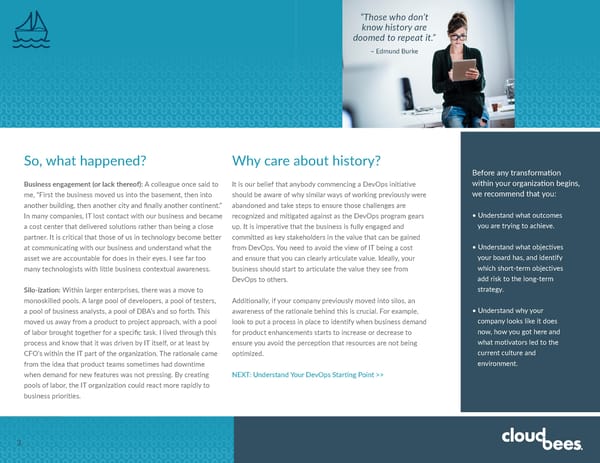
“Those who don’t know history are doomed to repeat it.” – Edmund Burke So, what happened? Why care about history? Before any transformation Business engagement (or lack thereof): A colleague once said to It is our belief that anybody commencing a DevOps initiative within your organization begins, me, “First the business moved us into the basement, then into should be aware of why similar ways of working previously were we recommend that you: another building, then another city and finally another continent.” abandoned and take steps to ensure those challenges are In many companies, IT lost contact with our business and became recognized and mitigated against as the DevOps program gears • Understand what outcomes a cost center that delivered solutions rather than being a close up. It is imperative that the business is fully engaged and you are trying to achieve. partner. It is critical that those of us in technology become better committed as key stakeholders in the value that can be gained at communicating with our business and understand what the from DevOps. You need to avoid the view of IT being a cost • Understand what objectives asset we are accountable for does in their eyes. I see far too and ensure that you can clearly articulate value. Ideally, your your board has, and identify many technologists with little business contextual awareness. business should start to articulate the value they see from which short-term objectives DevOps to others. add risk to the long-term Silo-ization: Within larger enterprises, there was a move to strategy. monoskilled pools. A large pool of developers, a pool of testers, Additionally, if your company previously moved into silos, an a pool of business analysts, a pool of DBA’s and so forth. This awareness of the rationale behind this is crucial. For example, • Understand why your moved us away from a product to project approach, with a pool look to put a process in place to identify when business demand company looks like it does of labor brought together for a specific task. I lived through this for product enhancements starts to increase or decrease to now, how you got here and process and know that it was driven by IT itself, or at least by ensure you avoid the perception that resources are not being what motivators led to the CFO’s within the IT part of the organization. The rationale came optimized. current culture and from the idea that product teams sometimes had downtime environment. when demand for new features was not pressing. By creating NEXT: Understand Your DevOps Starting Point >> pools of labor, the IT organization could react more rapidly to business priorities. 3.
 Charting a Course for the Enterprise Page 3 Page 5